

Largemouth Bass
North America's most popular freshwater game fish. How to identify a largemouth bass, where it lives, what it eats, how big it gets, when it spawns and how to catch one.
What is a largemouth bass?
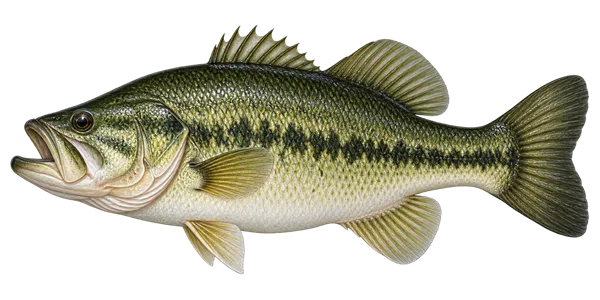
The largemouth bass (Micropterus salmoides) is a freshwater game fish in the sunfish family, native to eastern and central North America and now stocked worldwide. It is olive-green with a dark side stripe and a large mouth whose upper jaw reaches past the eye. Most weigh 1 to 5 pounds; the world record is 22 pounds 4 ounces. Bass live around weeds, wood and docks in lakes, ponds and slow rivers, and they spawn in spring.
Largemouth bass facts
| Scientific name | Micropterus salmoides |
|---|---|
| Family | Sunfish family (Centrarchidae), one of the black basses |
| Other names | Bigmouth, bucketmouth, black bass, green trout, Florida bass |
| Native range | Eastern and central North America, from the Great Lakes and Mississippi basin to the Gulf Coast and northeastern Mexico |
| Introduced | Throughout the United States and in many countries, including Japan, South Africa and Spain |
| Habitat | Lakes, ponds, reservoirs and slow rivers with weeds, wood or other cover |
| Diet | Fish, crayfish, frogs and insects; large bass also take snakes, mice and ducklings |
| Typical size | 12–20 in. and 1–5 lb; 10 lb and up is a trophy |
| World record | 22 lb 4 oz: Montgomery Lake, Georgia, 1932; tied at Lake Biwa, Japan, 2009 |
| Florida record | 17.27 lb |
| Lifespan | Usually 5–10 years; some live more than 15 |
| Spawning | Spring, when water reaches the low to mid 60s °F |
| Most active water temperature | About 65–80 °F |
| Conservation status | Least Concern (IUCN) |
| Good to eat? | Yes, smaller bass are mild and white-fleshed; most anglers release big ones |
How do you identify a largemouth bass?
Look at the mouth and the back fin. On a largemouth bass, the upper jaw extends past the back edge of the eye when the mouth is closed, and the spiny front part of the dorsal fin is almost separated from the soft back part by a deep notch.
Largemouth are olive to green on the back, fading to white on the belly, with a dark, often broken horizontal stripe along the side. Young fish show the stripe most clearly; big fish can look almost solid green or bronze in stained water.
| Feature | Largemouth bass | Smallmouth bass | Spotted bass |
|---|---|---|---|
| Jaw | Reaches past the eye | Ends below the middle of the eye | Ends below the eye |
| Dorsal fin | Deep notch, nearly two fins | Joined, shallow dip | Joined, shallow dip |
| Color and markings | Green with a dark side stripe | Bronze-brown with vertical bars | Green with a blotchy stripe and rows of small spots on the lower sides |
| Tongue | No tooth patch | No tooth patch | Small rough tooth patch |
Florida bass, native to peninsular Florida, is now listed as a separate species (Micropterus floridanus). It looks identical to the largemouth and is regulated the same way.
Where do largemouth bass live?
Largemouth bass are native to eastern and central North America and have been stocked in every region of the United States and in many other countries. They do best in warm, quiet, fairly clear water: natural lakes, ponds, reservoirs, backwaters and slow rivers. They tolerate a little salt and are sometimes caught in brackish creeks.
Bass are ambush predators and stay close to cover: aquatic grass, lily pads, reeds, fallen trees, stumps, docks, rocks and bridge pilings. Big bass also use offshore structure such as drop-offs, humps, ledges and channel edges, especially in summer and winter.
What do largemouth bass eat?
Young bass eat tiny drifting animals and insects, then switch to small fish once they reach about 2 inches. Adults eat almost anything that fits in their mouth: shad, shiners, sunfish, crayfish, frogs and large insects, and occasionally snakes, mice and ducklings.
Bass hunt mostly by sight and by sensing movement through their lateral line, which is why they feed best at dawn and dusk, on cloudy days and in slightly stained water.
How big do largemouth bass get, and how long do they live?
Most largemouth bass caught are 12 to 20 inches long and weigh 1 to 5 pounds. Females grow bigger than males. Bass grow fastest in long, warm growing seasons, so the South produces the most trophies; northern bass grow more slowly but often live longer. Most live 5 to 10 years, and some pass 15.
The all-tackle world record is 22 pounds 4 ounces, caught by George Perry in Montgomery Lake, Georgia, in 1932 and tied by Manabu Kurita at Lake Biwa, Japan, in 2009. The certified Florida record is 17.27 pounds.
When and how do largemouth bass spawn?
Largemouth bass spawn in spring, once the water warms into the low to mid 60s °F. That is as early as January in South Florida and as late as June in northern states.
Males fan out round beds, usually in 1 to 6 feet of water on sand, gravel or another firm bottom in a protected spot. A female lays thousands of eggs in the nest and leaves; the male guards the eggs, which hatch within a few days, and then guards the fry until they scatter. After spawning, big females rest and recover in slightly deeper water.
Largemouth bass seasonal patterns
Bass follow the same yearly cycle everywhere. The calendar dates shift with latitude; the water temperature is what matters.
| Phase | What the bass are doing and how to fish |
|---|---|
| Winter | Bass slow down in cold water and hold on deeper drop-offs, channel edges and warm-water areas. Fish slowly with jigs, jerkbaits and live bait. Warm afternoons are best. |
| Prespawn | As water warms toward 60 °F, big females move to the first drop-offs near spawning flats and feed heavily. Often the best time for a trophy. |
| Spawn | Bass bed in shallow, protected water with a firm bottom. Fish can be seen on beds; soft plastics and jigs worked slowly through the bed draw strikes. |
| Summer | Fish early and late. Topwater at first light, then deeper grass lines, ledges, humps and shade under docks and mats as the day heats up. |
| Fall | Cooling water sends bass chasing schools of baitfish into creeks and coves. Lipless crankbaits, spinnerbaits and topwater lures shine. |
Best conditions for largemouth bass fishing
Water temperature
Bass feed most actively from about 65 to 80 °F. Below 50 °F they slow down; in very warm water they move deeper or under shade and feed early and late.
Weather fronts
The day or two before a cold front, with falling pressure and clouds, is often excellent. The clear, bright days just after a front are the toughest: slow down and fish tight to cover.
Time of day
Dawn and dusk are prime, especially for topwater. On overcast days bass may feed all day; in cold months, the warmest part of the afternoon is often best.
Wind, current and water level
A light wind breaks up the surface and pushes baitfish onto windblown banks. In rivers and tidal water, moving current positions bass at points and creek mouths. Rising water pulls bass into flooded cover.
Best tackle and baits for largemouth bass
Rod
A 7-foot medium-heavy casting rod covers most largemouth fishing, from worms to jigs and spinnerbaits. Use a heavy flipping rod for thick grass and a medium spinning rod for light, weightless baits.
Line
12- to 20-pound monofilament or fluorocarbon in open water. 40- to 65-pound braided line for frogs, flipping matted grass and pulling bass out of heavy cover.
Leader
With braid in clear water, add a few feet of 12- to 20-pound fluorocarbon. In thick cover, most anglers tie braid straight to the hook.
Hooks & rigs
3/0 to 5/0 offset worm hooks for Texas- and Carolina-rigged soft plastics, which come through cover without snagging. For live shiners, a 2/0 to 5/0 hook through the lips or back; circle hooks reduce deep hooking.
Best live bait
Golden shiners, free-lined or under a float along weed edges. Crayfish, nightcrawlers and small sunfish (where legal) also work.
Fly fishing
A 7- or 8-weight rod with a floating line. Cast poppers and deer-hair bugs near cover at dawn and dusk, and strip streamers and baitfish patterns along drop-offs.
Most popular lures
Plastic worms, jigs, spinnerbaits, bladed swim jigs, crankbaits, lipless crankbaits, soft swimbaits, hollow-body frogs and walking topwaters. Carry both light and dark colors.
How to handle and release a largemouth bass
- Wet your hands and keep the fish in the water as much as you can.
- Hold small bass by the lower lip. Support big bass under the belly, and don't hang them straight down by the jaw.
- Use pliers to back the hook out. If a bass is hooked deep, cut the line near the hook.
- Take your photo quickly and let the fish swim off on its own.
Florida largemouth bass limits
- Bag limit: 5 black bass per person per day, in total. Only 1 may be 16 inches or longer.
- Size limit: no minimum length for largemouth or Florida bass.
- License: anglers 16 and older need a Florida freshwater fishing license unless exempt.
- Some lakes and Fish Management Areas have their own rules. Check FWC freshwater regulations before you go.
Rules checked October 2026.
Top largemouth bass fishing trips
Our most-reviewed bass trips. Each trip includes a licensed guide, a bass boat and fuel, rods, reels, tackle and life jackets.
- Okeechobee City, FL bass trips939 reviews
Lake Okeechobee's north shore. Wild-shiner and artificial trips for big bass.
- Clewiston, FL bass trips350 reviews
Lake Okeechobee's south end: grass, reeds and the rim canal.
- Stick Marsh & Headwaters Lake, FL bass trips200 reviews
Reservoirs near Fellsmere, west of Vero Beach, known for numbers of quality bass.
- Belle Glade, FL bass trips85 reviews
Lake Okeechobee's southeast shore and the Torry Island area.
- Orlando, FL bass trips63 reviews
The Butler Chain, Lake Toho and nearby lakes, close to the theme parks.
- Fort Lauderdale, FL bass trips54 reviews
Everglades canals with largemouth and peacock bass.
Top largemouth bass destinations
Top largemouth bass lakes
Seven of the best-known largemouth waters, from our home lakes in Florida to national tournament favorites.
 Florida
Lake Okeechobee
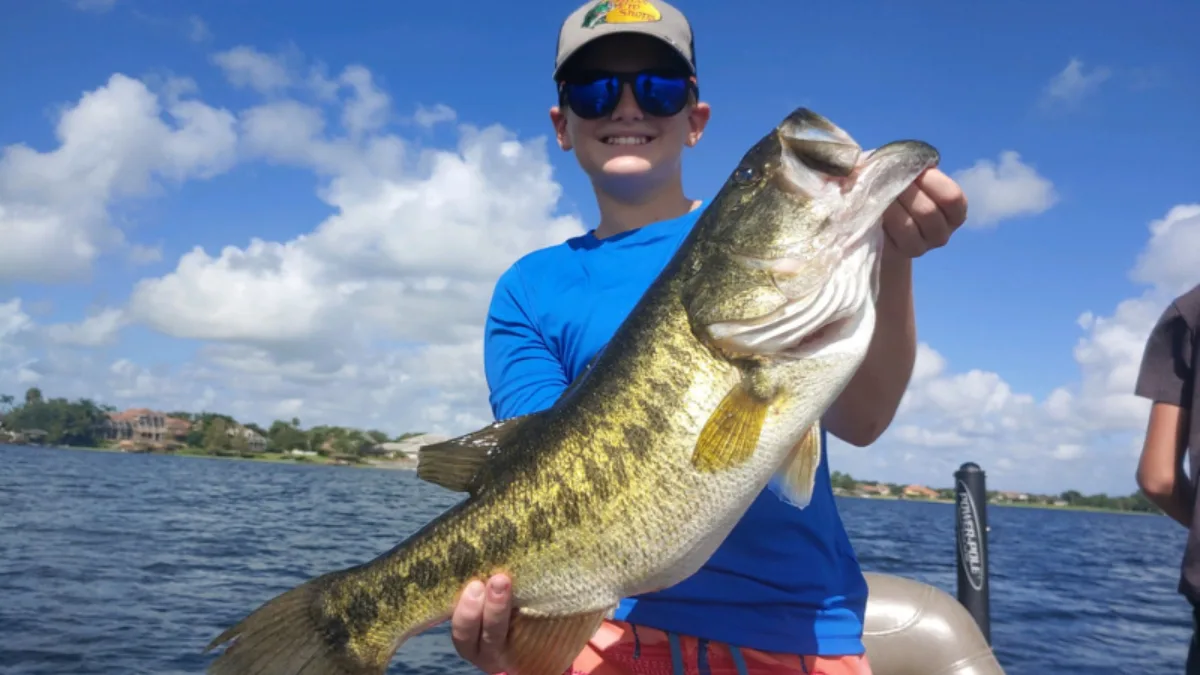
Florida's largest lake and one of the country's most famous bass fisheries: miles of reeds, Kissimmee grass and lily pads.
 Florida
Headwaters Lake
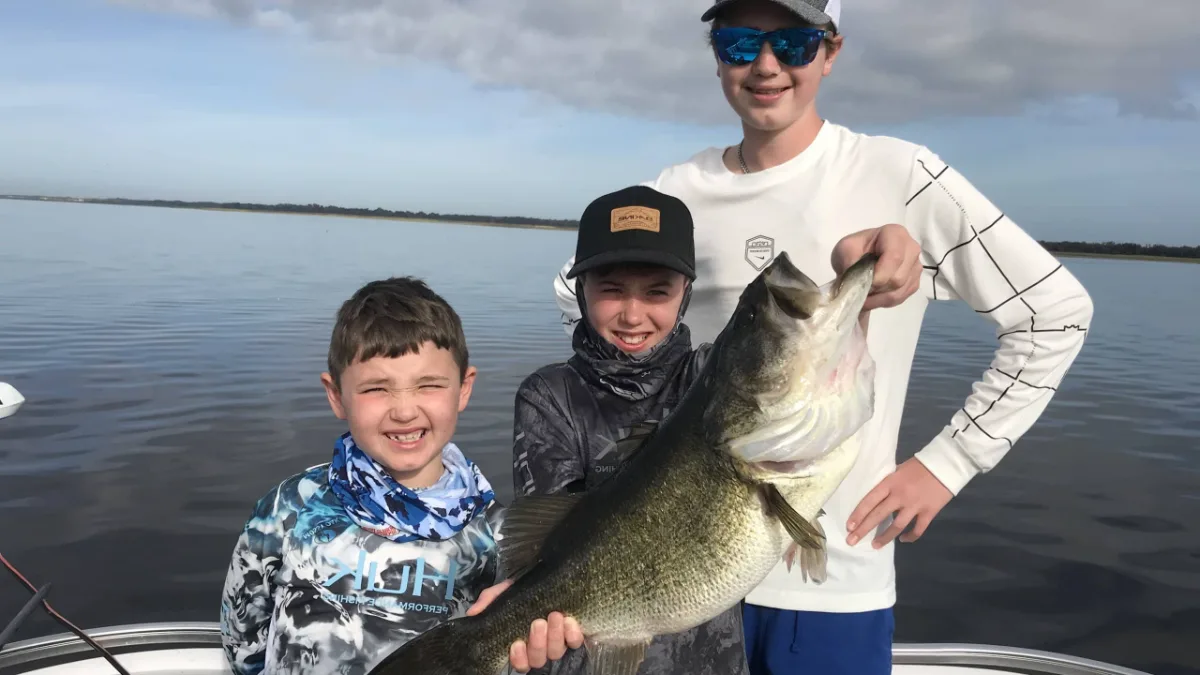
A newer reservoir near Fellsmere, next to the Stick Marsh, with standing timber and grass that hold a lot of bass.
 Florida
Lake Toho (Tohopekaliga)
A Kissimmee Chain lake south of Orlando with a long record of 10-pound-plus bass, heavy grass and open-water schools.
 Florida
Rodman Reservoir
A flooded-timber reservoir on the Ocklawaha River near Palatka, known for big largemouth bass.
 Florida
 Everglades
Hundreds of miles of canals and marsh with high numbers of largemouth bass, plus peacock bass in the southeast canals.
Lake Guntersville
A Tennessee River reservoir of about 69,000 acres in northeast Alabama, famous for its grass beds, big bass and national tournaments.
California Delta
The tidal Sacramento–San Joaquin River Delta: around 1,000 miles of sloughs and channels where Florida-strain bass grow to trophy size.
Reviews from our bass fishing trips
5.01,601 reviews
Had a great time with Capt. Cody! He was very knowledgeable about the area and went above and beyond for us. Would highly recommend to anyone looking to catch fish and have a great day on the water!
Brittany Ziobro · October 2026 · Google
Captain Brett was great! Put us on fish and iguanas. He went above and beyond, offering multiple suggestions on everything from places to eat and things to do after we finished. He was Easy to talk to and very friendly.
Rosa Babin · October 2026 · Google
Captain Paul is great! He made sure we had a really good time. Hope to see you again soon.Nancy, Jon and David
Nancy Pulling · October 2026 · Google
Great day with Captain Justin on his 19’ Nitro / 200 Yamaha. He put us on bigmouth bass, bluegill, and crappie, and he knows the fish, alligators, manatees, and Florida birds as well as he knows the water. Capable boat, knowledgeable captain — we’d go again.
Larry Franz · October 2026 · Google
Cody was our guide. We absolutely loved Captain Coby. He put on some monster fish and we had a blast. Awesome gyude service. Awesome Guide
tommy pomeroy · October 2026 · Google
We had a great 2 days fishing on Lake Okeechobee with Captain DJ Timms. He was excellent with the kids. We will be back!!
Nadra Woods · October 2026 · Google
Always enjoy coming out to fish Headwaters with Captain Paul! I’ll be back!
Jim Amsler · October 2026 · Google
Jose was wonderful! Thanks for a great time!
Elisha Stoecklin · October 2026 · Google
Camem was great! Knowledgeable and friendly!
Cindy Miller · October 2026 · Google
Great experience! Amazing view! So many crocodiles. Paul was outstanding with his service! Thank you
Nadezhda Cregg · September 2026 · Google
We did the cast and blast trip and were able to check a couple things off the list. One of the guys in our group was really wanting to catch a snakehead and got it done, and I was able to knock a peacock bass off my bucket list as well.We also got some good iguanas during the hunting portion of the…
Derek Marlin · September 2026 · Google
As an avid bass fisherwoman in TN, Okeechobee has always been on my bass lake bucket list and then add Mark Shephard as my guide and it couldn’t get much better! Fairly slow in the beginning but we ended up getting on a top water bite and it was game on! I will definitely be back!
Lindsey S · September 2026 · Google
Largemouth bass FAQ
When is the best time to catch largemouth bass?
Spring, around the spawn, when bass move shallow and the biggest females are easiest to reach. Spawning starts when the water warms into the low to mid 60s °F: as early as January in South Florida and as late as June in northern states. Fall, when bass chase baitfish before winter, is the next best season.
What is the best bait for largemouth bass?
Live golden shiners are the top live bait, especially for big bass. The most dependable artificial bait is a Texas-rigged plastic worm. Spinnerbaits, crankbaits, jigs, swimbaits and topwater frogs also catch bass, depending on the season and cover.
How big do largemouth bass get?
Most largemouth bass weigh 1 to 5 pounds and measure 12 to 20 inches. Females grow larger than males, and fish over 10 pounds are trophies. The world record is 22 pounds 4 ounces, set in Georgia in 1932 and tied in Japan in 2009.
What is the difference between largemouth and smallmouth bass?
On a largemouth the upper jaw reaches past the back edge of the eye, and the two parts of the dorsal fin are almost separated by a deep notch. Largemouth are green with a dark band along the side. Smallmouth are bronze-brown with vertical bars, the jaw ends below the eye, and the dorsal fin is joined.
How long do largemouth bass live?
Most largemouth bass live 5 to 10 years, and some live longer than 15. Bass in the North grow more slowly but often live longer than bass in warm southern waters.
Are largemouth bass good to eat?
Smaller largemouth bass have mild, white, flaky meat and can be good eating. Check local fish consumption advisories before keeping fish. Many anglers release larger bass, which are the most important spawners.
How many largemouth bass can you keep in Florida?
Five black bass per person per day, and only one of them may be 16 inches or longer. There is no minimum length for largemouth or Florida bass. Anglers 16 and older need a Florida freshwater fishing license unless exempt.
Related fish species
Smallmouth bass
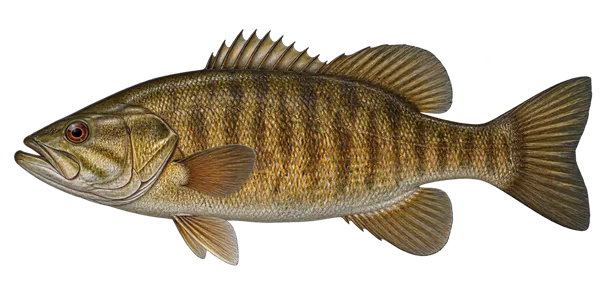
BronzebackThe bronze, hard-jumping cousin of clear, rocky northern lakes and rivers.

Peacock bass
Butterfly peacockA colorful South American bass found in South Florida canals.

Black crappie
Speckled perchA schooling panfish that shares bass water and is great eating.
← Back to Know Your Fish: all freshwater and saltwater species